Ways To Volunteer 

"No matter how much time I give, I always get more back." - OSF Hospice volunteer 

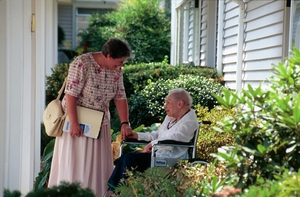
Hospice | Volunteer Visiting Patient

Volunteer services are an integral and important component of the hospice team's plan of care. Hospice volunteers choose their volunteer role they are most comfortable with.  During training, volunteers learn about hospice, the OSF team, death and dying, signs and symptoms of diagnosis, how to talk with the patients and their loved ones, religious and cultural diversity, and grief issues. Training classes are offered several times a year.

Volunteers are used in many different ways, from spending time with patients and their families, running errands, buying groceries, staying with the patient so the caregiver can go to appointments and more. They also assist with clerical duties, tracking data, assisting with memorial services, helping at foundation events or health fairs, or sending out cards and letters to families in our bereavement program. They shovel snow, plow sidewalks and driveways, and do yard work. Volunteers also visit patients in their homes or in the nursing home to read, pray, and socialize with them.

OSF Home Care Services also has a program called "No One Dies Alone" where volunteers sit with dying patients during their last hours.

To learn how to become a volunteer, please call (800) 673-5288.

Volunteer News

Central Illinois Hospice Volunteer Pays Back
Read the exciting article from WEEK-TV about OSF Hospice volunteer, Phil Millar, by clicking here.

Why I Chose OSF Hospice Volunteer Service
The following article appeared in the Sunday, June 6, 2010 edition of the Peoria Journal Star's Prime Times edition. It was written by OSF Hospice volunteer, Emma Hines.

"I retired in July 2008 after 38 ½ years of working with children and the final 24 ½ years of my professional career working with the public. The final five years of my professional career, were often times interrupted periodically with dreams of traveling to exciting and new places, meeting interesting people, having no specific commitment other than my scheduled medical appointments.

However in midsummer of 2009 I began to feel that a part of me was not complete. I began to analyze my life and realized that my life was not about me, it was not how much or what I received, rather what had I given of myself to others. 

I began to research the various local service organizations and prayed for God's guidance to help me chose an organization to be a servant to mankind.  After six weeks of OSF Hospice training, I was called with my first assignment. I was privileged to have a patient who though was very ill was able to verbally communicate. It was a good feeling for someone to say thank you or I really appreciate your help.

In October of 2009, I was asked if I was interested in assisting several Alzheimer's patients. I was very apprehensive because I did not fully understand an Alzheimer's diagnosis. I knew that the condition did not come with a curable prognosis. I further was of the opinion that the patient would not even be aware that I was in their presence. How would they be able to comprehend anything that I would or attempt to do for them? How very incorrect was my perception of these delicate and very precious patients.

I learned quickly through this volunteer ministry that even though the patients are not able to communicate verbally, I am able to see it in their eyes when I repeat the Lords Prayer, read them a bible story or attempt to sing a nursery rhyme or share large print pictures with them. They aren't able to recall all the words to the rhymes or songs but their reaction let's me know. They are patients who are very ill but they are like you and me, they cry, hurt and sometimes though very rarely will smile.

I discovered that if a patient is agitated or restless a tender stroke of the hand, a soft rub to the head and a quiet prayer will calm their restless spirit. I have a couple of patients who are usually in bed for an afternoon nap and reluctantly, I would enter their rooms, sing softly to them, hold their hands or softly stroke their arm.  Just as I'm about to leave the patients will open their eyes and in them I will be able to read thank you for dropping in today.

I have also been able to interact with the entire unit along with my assigned clients. They love to hear, your hair looks pretty today or what a beautiful sweater that is or just simply is there anything that I can do for you today?

OSF Hospice volunteering has enabled me to give unselfishly of myself in compassion and loving. I am now better able to understand the plight of the elderly. I look forward to fighting more fervently for their rights. 

Finally, I started this journey as a bi-monthly volunteer but the more I visited the more fulfilled I became. I now try to go once weekly. 

It is questionable whether they have actually helped me more than I have assisted them."

Volunteer Stories

"The volunteers helped keep my mother at home. She was so independent, but really needed the help. They brought groceries for her, helped with dishes and did little household chores. One lady brought her meals twice a week. It truly helped us keep her at home where she wanted to be."

"My sister was so afraid her children would forget her when she died. The social worker and volunteers helped her make a memory book for each of the children and tape videos of her reading books for them. They also helped her write a letter for each of their children to receive on their birthday each year until they were grown. She was so grateful and it gave her such comfort."

"My father was never lonely after we admitted him to hospice. Between the volunteers, nurses, social worker, and chaplain, he had company every day and sometimes several times a day."

"A 54-year-old wheelchair dependent woman with a 15-year history of Multiple Sclerosis and breast cancer with metastasis to the brain was admitted into Hospice. Her husband worked nights, making it impossible to leave her alone as she was unable to get out of bed without help. She could not have called for help in an emergency. In addition to providing standard Hospice care, a group of volunteers took turns staying one night a week with her from 10:00pm until 7:00am when her husband returned home from work. They kept this commitment for one full year. When she died, the volunteers were all at her funeral. When the husband attempted to thank them for all their support and hours of commitment, they each told him how much they enjoyed those nights. They also spoke about the early mornings spent visiting and praying with her. Each volunteer said they received far more then they gave that year."

Who was Gordon Benson?
Click here to read the story of a former hospice volunteer